Dialectical behavior therapy (DBT) is a modified type of cognitive behavioral therapy (CBT). Its main goals are to teach people how to live in the moment, develop healthy ways to cope with stress, regulate their emotions, and improve their relationships with others.DBT was originally intended to treat borderline personality disorder (BPD), but it has been adapted to treat other mental health conditions.
Mindful Skills
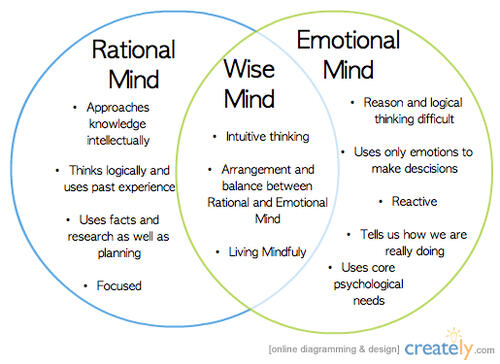
Observe: Observe your thoughts, feelings and experiencesDescribe: Describe your thoughts, feelings, and experiencesParticipate: Enter into the event
One-Mindfully: Do one thing at a time and completely focus on what you are doingNon-Judgmentally: Observe don't judgeEffectively: Do what works in a situation
Distress Tolerance Skills
STOP: Stop, Take a step back, Observe, Proceed MindfullyTIP: Temperature, Intense Exercise, Paced Breathing/Paired Muscle Relaxation/Progressive Muscle Relaxation (change your level of distress quickly)Distract using Wise Mind ACCEPTS: Distract yourself with Activities, Contributing, Comparisons, Emotions, Pushing away, Thoughts, SensationsSelf-Soothe: Use the senses (vision, hearing, taste, smell, touch) to soothe your physical self in order to make your emotions less painful.IMPROVE the Moment: Improve the moment with Imagery, Meaning, Prayer, Relaxation, One thing in the moment, Vacations, EncouragementPros and Cons: Examine the short term and long term pros and cons of acting and not acting on your urges/impulses using a chart.Radical Acceptance/Reality Acknowledgement: Acknowledge what is, let go of fighting or denying reality. Use TURNING THE MIND to commit to acknowledgement over and over again.
Interpersonal Effectiveness Skills
Clarified Priorities: What is most important to you in this interpersonal interaction 1) Obtaining your objective, 2) Maintaining the relationship, or 3) Maintaining your self-esteem/sense of self-worthDEAR MAN: Describe, Express, Assert, Reinforce, stay Mindful, Appear confident, Negotiate (used for saying “no” or asking for something; obtaining your objective)GIVE: Be Gentle, act/be Interested, Validate, use an Easy manner (used for maintaining a relationship)FAST: Be Fair, no Apologies, Stick to values, be Truthful (used to maintain your self-esteem/sense of self-worth)
Emotional Regulation Skills
PLEASE: Treat PhysicaL illness, balance Eating, avoid mood-Alerting drugs (as in street drugs or non-prescription drugs), balance Sleep, get ExerciseABC: Accumulate Positive Emotions/Experiences: Do pleasant things that are possible now. Make changes in your life so that positive events will occur more often.ABC: Build Mastery: Engage in activities that make you feel competent and in control.ABC: Cope Ahead: Rehearse a plan ahead of time so that you are prepared to cope skillfully with emotional situations.Opposite Action: Change emotions by acting opposite to current emotions/urges. Used for when emotions don’t fit the facts of a situation.Check the Facts: Check out whether your emotions or behavior fit the facts of the situation. Changing beliefs and assumptions to fit the facts can help you change your emotional reactions to situations.Problem Solve: When the facts themselves are the problem, solving emotional problems consistently and effectively will reduce the frequency of negative emotions and increase your sense of competency in regards to dealing with these emotions/urges.
Things that help:- Write down a list of things you don’t like about yourself and find healthy/realistic ways you can change them, if you can’t change them try to find ways to accept them
- Write down things you like about yourself!
- Practice self neutrality
- Start a gratitude journal / think of one thing you’re grateful for each day
- Practice good grooming habits
- Try to eat healthy and balanced
- Reward yourself for trying your best even when you fail
- Remind yourself that nobody is perfect and you’re not the exception
- Take your medication (if you have any)
- Meditate
- Get dressed everyday
- Get out of bed everyday
- Build a good support system (online counts)
- Use daily affirmations such as “I am not my failures” and “Its okay to not be perfect”
- Be honest with your therapist/psych
- Try to listen to others
- If you have good supports and you really want attention, just ask
- Do things you’re good at and you actually enjoy
- Practice coping skills even when you are not upset
- Apologize when you hurt someone and if you’re not good at that, practice in the mirror or with someone